Adi Ben-Ari (00:00):
Welcome to the Applied Edge podcast. I'm Adi Ben-Ari, and this is the show where enterprise leaders talk candidly about technology decisions reshaping their industries, whether it's AI, blockchain, privacy, and what it actually takes to deploy them at scale.
Adi Ben-Ari (00:12):
There's not a single area of the bank that is not being touched by AI. You can buy a coconut on the beach and you will pay with your credit card because everything has been digitized. You need to jump on this boat, because you're going to be left behind.
Adi Ben-Ari (00:25):
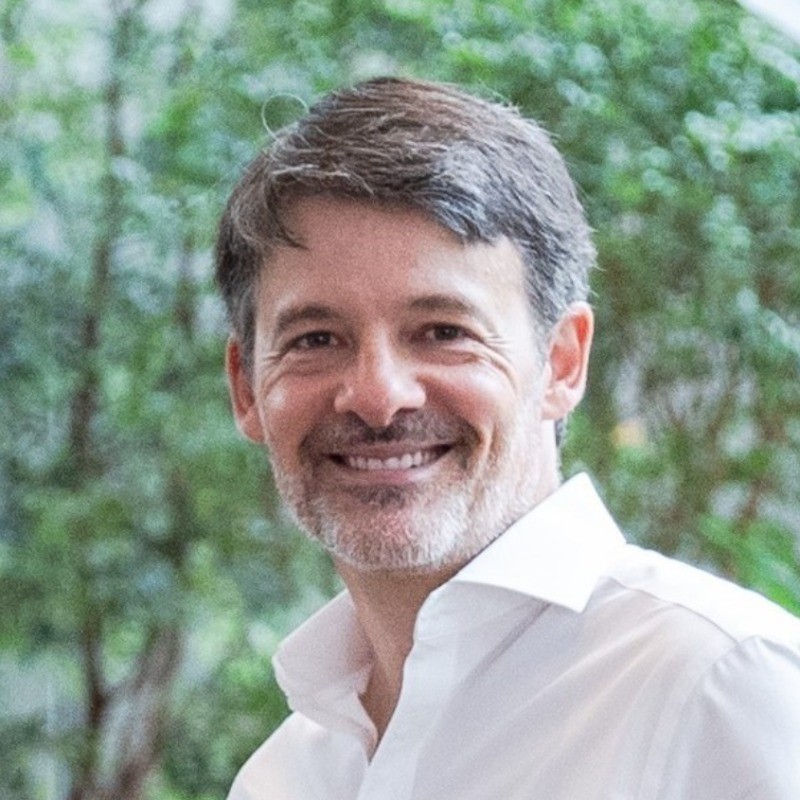
My guest today is Eduardo Alvarez, Partner of Strategy and Chief Data and AI Officer at Santander Brazil. Brazil has become one of the most digitally advanced banking markets in the world, and Santander has been in the middle of that transformation for over a decade. Eduardo sits at the intersection of strategy and AI inside one of the biggest players, which makes him exactly the right person to talk to about what enterprise AI actually looks like.
Adi Ben-Ari (00:48):
Eduardo Alvarez, welcome to the Applied Edge podcast.
Eduardo Alvarez (00:52):
Thank you very much. A pleasure to be here with you.
Adi Ben-Ari (00:54):
Eduardo, please, for our listeners, explain a little bit about your role, I understand you're Partner of Strategy and Chief Data and AI Officer at Santander in Brazil. Please explain to us a little bit about your background, what you do, and so on.
Eduardo Alvarez (01:07):
Correct. I lead the strategy and the data and artificial intelligence areas at Santander Brazil. My background: I majored in finance, business administration, and also law, I did a double degree, and then I started traveling for work. I did consulting for almost ten years, both in the IT and strategy areas. Then I moved to Brazil and started working for Santander.
Eduardo Alvarez (01:32):
Then back to Spain. I've worked in twelve different countries, visited almost sixty, and lived in six. I went back to Spain in 2014 to work for a large private equity fund with real estate assets, then came back to Brazil in 2020, in the middle of the pandemic, and worked in health investment for another private equity fund, and finally went back to Santander.
Eduardo Alvarez (01:55):
This is my second spell at Santander, starting September 22nd, initially as Head of Strategy, and then I added different responsibilities. And the latest one, since last year, is leading the data and artificial intelligence transformation, which is how we're looking at this: as a complete transformation of how we do business and how we work in the bank.
Eduardo Alvarez (02:15):
And obviously, as a societal change, more than just looking at ourselves and thinking the bank is going to change, it's pretty much everything that's being touched by this.
Adi Ben-Ari (02:25):
Amazing. Eduardo, as I've come to understand it, Brazil is one of the most advanced countries when it comes to digital banking and fintech. How do you explain this from your perspective? How do you look at this, and how do you explain it?
Eduardo Alvarez (02:35):
Well, this was a big shock for me, because I left Brazil in 2013. And when I left Brazil, one of the main conversation topics among bankers was how we're going to get everyone banked. We had a large unbanked population, a pretty large informal economy, so it was tough to see how to get that huge segment of the population into the financial services system.
Eduardo Alvarez (03:03):
And when I came back in 2020, that wasn't a conversation topic anymore, everyone was banked. The magic had to do with, I think, two main elements. One of those was the regulator: the Central Bank has been extremely active in fomenting competition and bringing technology into the daily lives of Brazilians. So there are two big elements here. First is Pix, the P2P money transfer system launched by the Brazilian central bank just five years ago.
Eduardo Alvarez (03:34):
It seems like you wouldn't understand Brazil without Pix, but the fact is it's only been here for five years, and it completely changed the way Brazilians use their money daily. There's just no cash anymore. Cash used to be big in the country, ATMs were everywhere, you'd pay for plenty of things with cash, and now it's disappeared. You can buy a coconut on the beach and pay with your credit card, or with Pix, because everything's been digitized. Pix works through a mobile app, and you can pay for anything.
Eduardo Alvarez (04:16):
It's not just that you can do P2P transfers, which was the initial idea, you can pay in stores, you can pay in installments, on Pix installments, you can use it for any kind of payment. Businesses use Pix to pay other businesses, it's replaced traditional transfers, and it's by far the biggest adoption of any payment method seen worldwide.
Eduardo Alvarez (04:50):
In one year, everyone was using Pix, and because everyone was using Pix for their daily payments, this forced, in a good way, everyone to have a banking app, because without the app you couldn't pay. And now everyone has between 3 and 4 current accounts across different banks. There are over a billion accounts in Brazil, and there's 200 million people, so it's like five each. If you take just personal accounts, it's about three each, and the number of active accounts per Brazilian is staggering.
Adi Ben-Ari (05:14):
And behind Pix, you have a bank account?
Eduardo Alvarez (05:16):
Yes, you need to have a bank account, and you have a Pix key, which can be your ID, your mobile phone, or your email address. It's extremely flexible, and it's managed by the Central Bank but developed with plenty of support from the banks, who were kindly invited by the Central Bank to join this revolution. And the functionality hasn't stopped yet, in a few months you'll be able to use Pix almost like a credit card.
Eduardo Alvarez (05:45):
Pix has been replacing cash, and to a much lesser extent, debit cards have also been impacted. Now it's moving into other types of payments, and we'll see how that goes.
Adi Ben-Ari (06:01):
And presumably lending is plugged into that too?
Eduardo Alvarez (06:05):
Yes, yes. You can already do payments in installments with Pix. It's catching any type of payment you can think of.
Eduardo Alvarez (06:13):
So this was one catalyst, and the other was open finance. The open banking that the Brazilian central bank pushed is, I'd say, the most transparent I've seen. Santander is in plenty of countries, and I've seen different approaches to sharing your information with other banks so they can give you better offers.
Eduardo Alvarez (06:38):
But there's nothing I've seen at the level of Brazil. You receive push messages saying, "you're paying X with this bank, you could be paying 20% less if you came with us," or "you're getting this return on your investment with this product from your current bank, you could be getting 10% more if you came with us."
Eduardo Alvarez (07:01):
So they have all the numbers on your credit or your investments, once you consent to share your information, and the banks can make offers 100% tailored to what you're paying and what you'd be paying. So it's extremely attractive, and those two things have increased competition and digitalized the lives of Brazilians at a pace I wouldn't have thought possible.
Adi Ben-Ari (07:28):
That's very interesting, because obviously we have open banking, we've had it in the UK for many years, but it hasn't really had a big impact. It's interesting to see how these things come together. And then, AI, how do you look at this from your perspective?
Eduardo Alvarez (07:46):
What we've seen is: this is not just a tool. If you think of it only as a technology area, you're catching maybe 30% of what it actually implies. And I say this because you can think of use cases for pretty much every employee in the bank, because it implies a change in the way we work. That would fall short if we just stick to the technology. There's so much change management to do here, and so many cross-functional projects that impact operations and the front office.
Eduardo Alvarez (08:23):
There's not a single area of the bank that isn't being touched by AI. So what we did at Santander was split out the AI area and the data area, so they report directly to top management, both at the group center and in each of the countries. We've become transformation agents. What we're doing now is training people, adding new tools, adding specific vertical tools that help in each area, helping people change the way they work.
Eduardo Alvarez (08:41):
Because you've been working a certain way for 10, 15, 20 years, and then suddenly you're being told, "here's Claude, here's GPT, whatever LLM or adaptation of an LLM you have, it's going to help you be more productive." It's not intuitive, it's not something you do easily, like switching from one spreadsheet provider to another.
Eduardo Alvarez (09:07):
This isn't just another tool provider you already have, it's something new, and you need to integrate it into the day-to-day. That's why it's a huge change management program. It has some large use cases that can be identified top-down, but others depend on each individual understanding how it works, it's not top-down, you can't just tell someone how their work is going to improve.
Eduardo Alvarez (09:38):
Once they understand how it works, the ideas are endless, and that's where the most proactive stuff shows up.
Adi Ben-Ari (09:48):
So, first of all, you separated AI, strategy, and data from IT itself, right? So you're running it as a separate unit, reporting to the top.
Eduardo Alvarez (09:56):
Right. Yes.
Adi Ben-Ari (09:58):
Okay. And then how do you decide what to work on, and how do you drive that? Because you have to drive that change along the way, into different parts of the organization, right?
Eduardo Alvarez (10:03):
Right. There were four or five areas that, from the beginning, we thought needed special focus, these were no-brainers. For instance, making your operations automatic, amazingly enough, in 2026, there's still plenty of manual intervention in the back office of banks.
Eduardo Alvarez (10:32):
And I'm pretty sure you're well aware of that. It's not just about automating those processes, it's about really rethinking them from scratch, because the tools you have with AI let you do that, not just automate the process, but rethink it and make it even more efficient. So we're reinventing our back office.
Eduardo Alvarez (10:55):
That's not an exaggeration, we're reinventing our back office. That was one vertical that was very clear from the beginning. Another one was coding, and you're well aware of that, it's probably one of the toughest change-management efforts, to talk to your developers and say, "you don't need to write every line of code anymore."
Eduardo Alvarez (11:17):
One of the advantages we have as a global group is that we have a venture capital fund called Mouro Capital, and they've been very active investing in companies that looked really promising in the AI world. They brought them to us so we could test their services, and one of them is Cognition. They just got a billion dollars in financing at a 26 billion dollar valuation.
Eduardo Alvarez (11:42):
And they do this near-autonomous coding that lets you go a lot faster on whatever you're writing. And that's been, for us, a complete game changer. From February to now, we've gone from 5% to 85% of coders using this. This is for new systems.
Adi Ben-Ari (12:04):
Is this for new systems, Eduardo?
Eduardo Alvarez (12:06):
Or it can also be used for updating existing systems, new systems are automated too, and it's used in the review of old systems that need updating every year. We haven't gone for the full "let's rethink all our legacy systems" yet, but the maintenance of those systems is today ten times easier than it used to be. The building of new systems is on a completely different level.
Eduardo Alvarez (12:35):
So coding was a clear vertical, and here you need incentives for people to test it and see how it works. But once they get the hang of it, the main point is they understand this is the future, and there's no way back to the old way of coding, unless it's something very small, and even then it's barely worth it.
Adi Ben-Ari (12:58):
And once you see the rest of the market testing that kind of approach too, and see it working in your own company, that makes the change a lot easier.
Eduardo Alvarez (13:08):
Another vertical we saw from the beginning was conversational AI, for large services organizations with customer bases in the millions.
Adi Ben-Ari (13:18):
That's for customer support, right?
Eduardo Alvarez (13:19):
Yeah, customer support is really important, and having something that understands the customer's data and can process a fast, well-structured answer makes a huge difference for us. So for each of these, we've been looking for partners using LLMs in a more vertical, specialized way, and we found them.
Eduardo Alvarez (13:47):
And then we have individual productivity, the tools we're giving to every single employee. Since two or three weeks ago, everyone has Copilot Chat working for them. And that's where we're seeing the most change in people's day-to-day, because they now start the day looking at what their agents suggest they should be doing, whether that's how to prepare for a meeting or how to develop a product.
Eduardo Alvarez (14:20):
And that's becoming engaging, a new way of working.
Adi Ben-Ari (14:22):
I was telling someone the other day, I use AI a lot too, but it's still quite hard to quantify what I'm actually getting from it. But if you took it away from me now?
Eduardo Alvarez (14:33):
Yes,
Adi Ben-Ari (14:34):
oh my God, that would feel like going back to the Stone Age.
Eduardo Alvarez (14:39):
Yeah, that to me is the best test. We're obviously trying to quantify it, and we work with the finance area to see how it was before and how it looks today. But the fact is, when I say "okay, we don't have it anymore, how do we solve this, how do we change this process," everyone goes, "okay, understood, yes, we can't live without this now."
Adi Ben-Ari (15:08):
And how do you... I mean, I understand how someone like you in your position gets it, right? You've got the high-level view of the operations, the market, and so on. But you're dealing with a bank, a large, conservative, risk-averse organization, with a lot of people who've been working their processes, doing the same thing for a long time, and risk is one of the big considerations for them. How do you deal with the culture? How do you get people to actually change what they're doing on the ground?
Eduardo Alvarez (15:46):
You're right that risk is, and especially at Santander, I believe it's something so important that we wouldn't be here if we hadn't taken care of it for over a hundred years. But I guess, from the beginning, security and risk have been the priority. Every provider we test, we look closely at cyber, fraud, and any potential gap in those areas.
Eduardo Alvarez (16:30):
I always say my visit to the cyber department at the corporate center is one of the most amazing things I've done in my life. It's amazing how developed, and how careful, we are with anything that could arise from that. Every tool is triple-tested, we make sure nothing goes into production that hasn't been properly audited, and in some cases it makes us slow down some decisions.
Eduardo Alvarez (17:02):
And I think that's right, because this isn't yet a well-structured market, the tools aren't 100% what they will be in the future, this isn't mature by any stretch of the imagination. In those situations, you need to be extra careful. Even though the transformation is clear, and we're in very competitive markets where we need to be fast adopting new technologies, risk is always part of what we do. And it wouldn't be us if we weren't doing this.
Adi Ben-Ari (17:48):
But I'm also interested in the people, the culture, of adopting it, because AI can still create fear in people. People don't always know where to start with it, there's a lot of pressure to use it, but they don't really know what to do. You talked about developers, for example, it's something I've experienced with my own team, right? Sometimes it's the non-technical people, people who've never coded, who take Claude and suddenly produce amazing applications, and the coders are saying, "hang on, hang on, you can't just do that, I want to make sure this is okay."
Adi Ben-Ari (18:06):
So how do you deal with, especially in a large organization, the cultural side of getting people to actually take this on and use it in a positive way, to embrace it?
Eduardo Alvarez (18:41):
The risk side, even among developers, is well covered, we have red teams, people trying to break those tools constantly, so everyone knows you can always find something that wasn't 100% as expected. And we have great test teams. But for adoption, we have a specific team dedicated to fostering it, because we believe this isn't going to work if you just hand it over. It's like giving a teenager the keys to the car and saying "okay, drive," it's not going to work, and it's not going to work well.
Eduardo Alvarez (19:04):
Adoption is different for a developer, different for a bank manager, different for someone on my strategy team, what they can do with it is different in each case. So you need tailored training programs, tailored incentives, and of course, time to experiment with the tools. To me, that's the most important thing, you need a few hours in your day where your job is just to test it, play with it, see how far it can go, where it might make a mistake, and how you go about avoiding that mistake.
Eduardo Alvarez (19:38):
And if you don't do that, rejection is easy, it's just "I don't want to use this, I'm good at my job." No, I'm sorry, you were good at your job the way that job was two years ago. Your job isn't that anymore. It doesn't work like that. It's tough to hear, but it's the way things are right now.
Adi Ben-Ari (19:57):
Yeah, it's an important thing to communicate. The world is changing, and you really want to give people the tools, empower them to be part of that, and help the organization face into it. If you don't, it's tough to see how that moves forward. And again, the competitive environment matters a lot here.
Eduardo Alvarez (20:19):
Other companies will do it, other developers will do it, other strategy managers will do it. You need to jump on this boat, because you're going to be left behind.
Adi Ben-Ari (20:41):
Yeah, it's interesting, because maybe that competitive fintech and banking environment you have in Brazil has also created that same competitive environment for AI. You're going to have to be on it, there's almost a greater driver here than in other markets, where the incumbent competitors might be slower.
Eduardo Alvarez (21:08):
Yes, we have all types of competitors here in the banking sector, I don't think it's the same in other sectors. But here, with the fintechs, the big techs, and the retailers, you've got competitors everywhere, including in how you pay. And obviously the incumbent banks were really good to start with, I think the push towards technology and AI has been really, really strong.
Adi Ben-Ari (21:24):
And Eduardo, one of your hats is strategy, where do you see this going? What's the direction of travel from your perspective?
Eduardo Alvarez (21:31):
I have a bias, which is a financial-sector bias. And I think there's something that may happen in Brazil first, and happen in other countries later, which is: disintermediation is a huge risk for banks. What I mean is: you won't need to use the bank's app, you won't need to talk to a bank employee, you'll have your own financial services agent that takes care of all your finances.
Eduardo Alvarez (21:57):
The reason I say this may happen in Brazil before other countries is that, with open finance, you could do that now. Theoretically, you could have an agent that, with your consent, accesses all your accounts and tells you "this is the best credit card for you to use now because it gives you more mileage," or "this is the best mortgage, because I've already compared all the conditions and this is the best for your profile, for what you need right now," or "this is your best investment today."
Eduardo Alvarez (22:25):
If you don't want to use the money for the next couple of years, out of all your accounts, this is the best. This could be done now in Brazil, and it's starting, timidly, to happen bit by bit, first with payments, and we'll see that progress.
Eduardo Alvarez (22:53):
And if you think, in ten years' time, that's how our financial lives should work, strategically it makes sense to think: how do we get into that boat, rather than watch how the boat departs from the seashore? The main thing here is to have screen time with the client, because otherwise you become a provider of balances, not a company that's in touch with its clients. That's the biggest risk, to me.
Adi Ben-Ari (23:12):
So it's the customer relationship, at the end of the day. Interesting. Eduardo, first of all, thank you very much for your time, it's been super interesting. I want to ask, we met at an AI course, at the LSE, that was a great course, we had some amazing lecturers there, and it was a great source for understanding more about AI and organizations, and thinking about things a bit differently. I want to ask, do you have any other sources of information, maybe books, or people you follow, that you'd recommend for others who want to get into this more and learn more?
Eduardo Alvarez (23:34):
There are quite a few. I use X far more than I probably should. I still write about football, and speak about football on the BBC, so I started out as a football writer, or journalist, and then I started following a completely different breed of people.
Eduardo Alvarez (24:02):
So, from the AI standpoint, the tutorials from Anthropic are fantastic. Following Karpathy always gives you a point you probably hadn't considered, his perspective is fantastic. There are some writers doing a pretty good job translating what's happening into layman's terms, so people understand it.
Eduardo Alvarez (24:23):
But I do believe you need to devote some time to understanding how it works, because there's a difference between someone just putting it into words you understand, and someone who's actually talking about the technology. That's why Karpathy is one, at a very high level, it's good for understanding where things are going. That said, I don't want to be completely separated from the real economy, because this has to work in a market, in an environment.
Eduardo Alvarez (24:55):
And that's why I keep reading about things that happened in the past, for instance, Andrew Ross Sorkin's 1929: Inside the Crash, I'm finishing the book now, I'm enjoying it immensely. I think you need a balance between what's going on in tech and what could happen in the market, both things are very important, to be ready.
Adi Ben-Ari (25:20):
Okay, so learning from history as well, from the past, I guess. Interesting. And you bring up the football, I mean, just in terms of timing, I watched the Japan Brazil game yesterday.
Eduardo Alvarez (25:26):
Oh my god, I'm not sure you know this, but the country stops two hours before the match. People can go home, and then they can only go back to work two hours after the match. So if the match is at night, nothing happens. But if the match is like yesterday, at 2pm, people leave at noon, and then they should be back at the office at six, but it's too late.
Eduardo Alvarez (25:55):
So basically, everything stops. There's no other subject in the news.
Adi Ben-Ari (26:09):
It's unbelievable, it's all anyone talks about, they just replay it a few more times.
Eduardo Alvarez (26:15):
It just keeps going.
Adi Ben-Ari (26:17):
Yes, yes.
Eduardo Alvarez (26:18):
Productivity's still okay.
Adi Ben-Ari (26:21):
Well, amazing, Eduardo, it's been a real pleasure, thank you very much for agreeing to join us, really appreciate your time. Let's stay in touch.
Eduardo Alvarez (26:33):
It's been a huge pleasure, thanks for inviting me, for having me here, I really had a great time.
Adi Ben-Ari (26:35):
That was Eduardo Alvarez, Partner of Strategy and Chief Data and AI Officer, Santander Brazil. If you enjoyed that conversation and want to hear more from leaders like Eduardo, who are shaping enterprise tech, AI, and blockchain, subscribe wherever you listen to the show.